Friday, 24 March 2017

Memory Loop

 Sometimes when I'm thinking about projects or pieces, I get so struck by the infinite clamour of possibilities that I can't move. There are moments when the sheer monumentality of the possible - even within the paucity of resources and the constraints that I impose on myself - is so overwhelming that my mind freezes.
Sometimes, the way out of this is to go and literally throw paint/words/ink, whatever onto paper and see what emerges. Other times, I just need to walk away and get out of the house. Each of these strategies has its proper place, though there's no way of knowing what's appropriate at any given moment. On other days of course, it's starkly obvious what needs to be done - all I have to do is get it done.


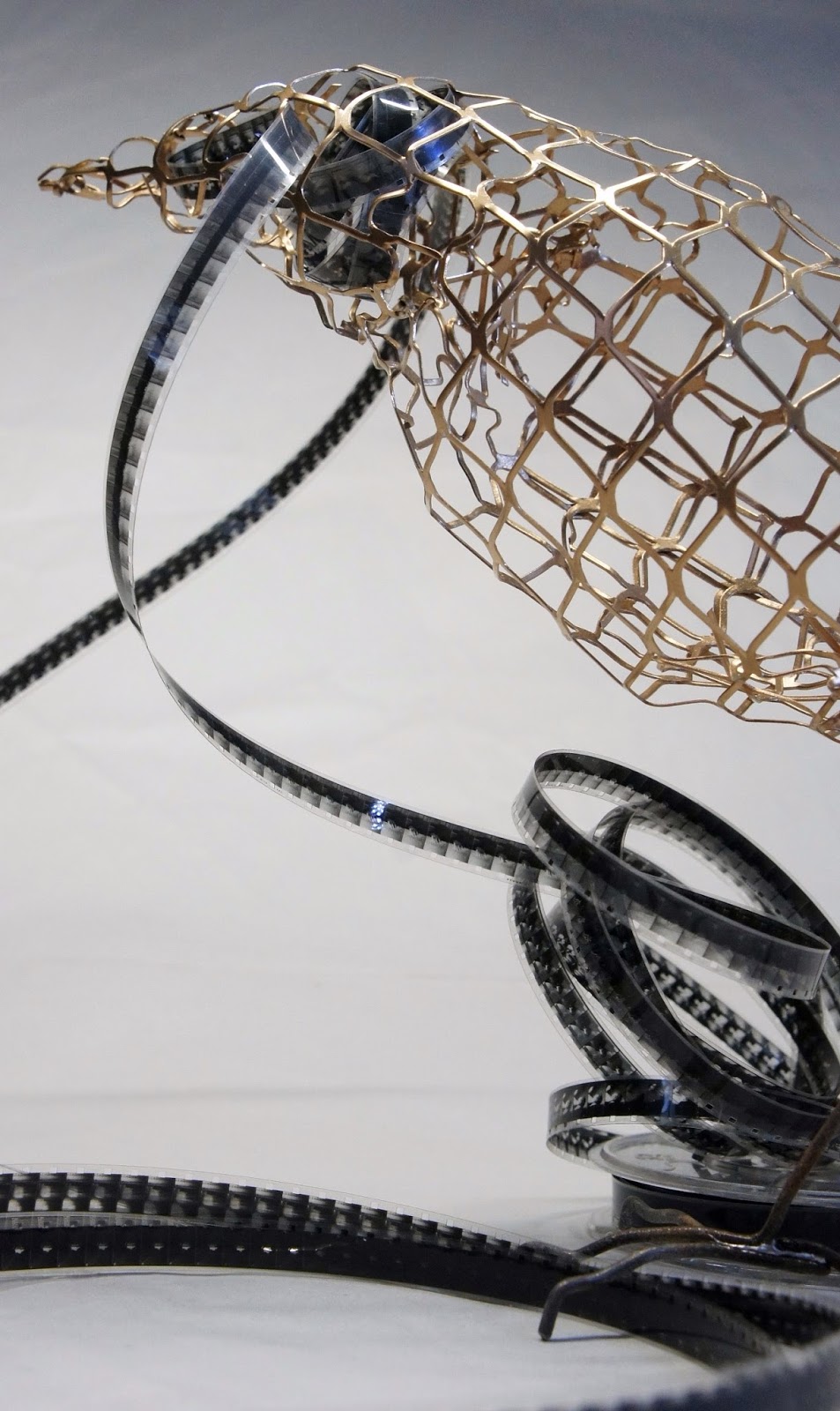
This bird here is one of those. I've written about the birds before. Their story is well told. But I'm forever searching for new contexts and narratives within them. The film here is an 8mm, black and white, home cine film called, rather dramatically "Bloodsucker". It's a vampire film apparently. Doesn't really matter, it could be anything. That's the nature of memory, and here's the point.
Learning is the process of establishing new memories. Processes, events, important data, sequences, directions etc. It's a lot like cramming film or tape into your head. Gradually your head fills up and as the space fills, the film gets tangled and knotted, until your head can hold no more and the tape/film spills out around your feet, tangling and tripping you, tying you down, tethering you to the spot.

This is just one iteration of this idea, and it's open enough to allow multiple readings. Perhaps the nature and specifics of the film do matter? Maybe it could be replaced by a number of different media producing several different narratives/contexts/subtexts? 
Maybe... maybe... maybe... it all becomes horribly elliptical again after all.

Monday, 20 March 2017

"Book-A-Day" Artists' Book Project 2017


This is a personal project that I've begun as a way of firing the synapses and motivating the mojo, banishing the procrastination and freeing myself up from conventional mundanity. 

I've spoken/written a couple of times about my methodology and how it is so dramatically shaped by deeply restricted resources, and this project is another great way to explore that. So, there are some fundamental 'rules'.  
  • First, the aesthetics have got to be there in terms of quality.
  • Second, all analogue.  
  • Third, NO digital!  
  • Fourth, some processes necessarily take a little time, such as glue drying. There's no cheating on this if I want the work to last, so some books may take longer than a day to actually produce.  That means, probably several books on the go at one time.  The object is to get a book produced, photographed and online at least once a day - for as long as I can maintain...  If the project goes a week, I'll be chuffed!
  • Fifth, edition where possible. 

All of the books made under the aegis of the project will be available for sale on the site here, and you can follow my progress on INSTAGRAM  and TWITTER.


Tuesday, 21 February 2017

Aspex Gallery, Portsmouth and the Ministry Of Books

‘Ministry Of Books’ at Aspex Portsmouth 
11th Jan – 2nd April 2017


There is a delightful and cleverly curated introduction to the world of artists’ books, multiples and artefacts in the foyer of Aspex Gallery, Portsmouth. On display is a sample of the collection held by 'Ministry of Books' at the University of Portsmouth. Twenty or so moderately small publications cover abstract, whimsical, philosophical, poetic and cultural subjects questioning our humility, humanity and habits. Some are about mapping aspects of the psyche - others are informative, commemorative and exploratory. Juxtapositions of romance, fear, curiosity and commercialism make for a brief essay of human mores and habits seen through the ever inquisitive eyes and minds of artists. 
Artists books can challenge conventional content and purpose seen in traditional publications. But this raises the question - beyond mobility, portability and sharing what is a 'book' or any such artefact for, if not to communicate? Expression for the sake of expression is meaningless without something to communicate - a direct appeal to the reader's attention. There aren’t many overt ‘stories’ here. Largely these are commentaries, observations and statements that tend to be ‘sound bite’ structured, succinct in nature - at least on the surface. Investigation of context and subtext is for the reader to ponder on. Narratives are (de)constructed and presented through images and forms that are sometimes explicit, sometimes not so. 
Patricia Collins' humble 'Mail Art Book' is a small package wrapped in brown paper, tied with string, addressed to somewhere in Paris, France. We are told that it was part of a series of miniature boxes sent through the post in the late nineties. That's all. It is what it is. But this unpresuming object is patinated, with the tarnish of its almost twenty year journey here. This wonderful little thing appeals to the nostalgic in us, a quiet powerful sense of history without braggadocio or exhibitionism.


‘A Little Book To Be Taken Out Always, Just In Case’ is one of the smaller books that immediately pings on the conscience. This is a subtle little book with the appearance of a cheap book of raffle tickets. I’m sure this association is not insignificant. The pages are a set of perforated tear out pink tickets, printed on one stub with ‘Your Number’ and on the other, ‘My Number’. It has been used - there are a couple of tickets missing and numbers written on stubs. Such details you must look for and consciously register. What sort of person would carry - and use - such a book? Promiscuous? Needy? Insecure? Such an innocuous thing, but what would you say if you found a copy in your daughters’ handbag? It sends a little shiver down the spine.


Happily, Portsmouth’s great literary history is represented with the inclusion of Sadie Tierney’s ’12 Plates Inspired by Charles Dickens’ “The Chimes”’. Created for the ‘Beyond Dickens’ exhibition in 2012, its themes of time passing, New Year and hope are tenderly rendered in 12 small etchings drawn from the Dickens short novel.


There is much, much more to the twenty books on display here. For an introduction to a field of artistic endeavour as broad as artists multiples and objects, this is as strong and well considered a collection as you could wish for.

To find out more about the full Ministry of Books collection and the exhibit at Aspex go to:
https://www.aspex.org.uk/whats-on/exhibitions/the-ministry-of-books/
http://theministryofbooks.blogspot.co.uk/

Tuesday, 31 January 2017

Typonegative II


Edition of 20. Signed, dated, numbered.
 - 44 pages
 - full colour
 - 11cm x 11cm


*There is No Digital Printing in this edition. 
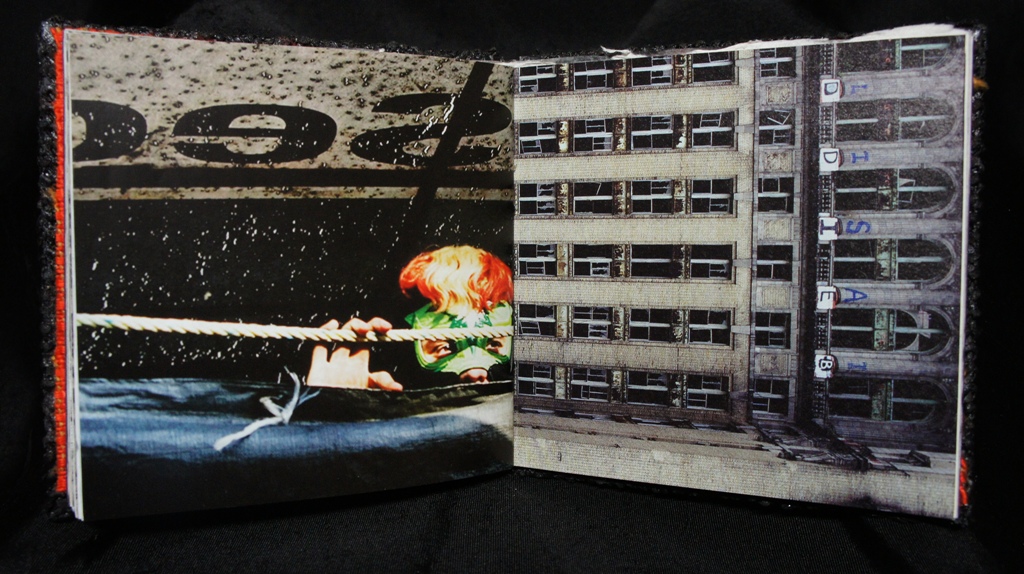
It's all about the surface qualities! These are visceral, tactile artefacts. The size, shape and texture have a distinctive feel, like the visual impact of every page. Narrative and meaning are strongly affected by contrasting imagery. The text is deeply embedded in the context and this structure in return, shapes the narrative.

Context is everything. The surface of the image is our cage. Reductionism, imposed and innate, in conjunction with non-linear image and abstract narratives, snapshots and soundbites, define moments. 160 characters to express the breadth, depth and height of humanity as it stands here, now. This is how we have come to see our small corner of the planet Earth. Empires imploding, collapsing in on themselves while refugees of unreconstructed cultures look on with a mixture of glee and horror.

Glossy magazine pages are cropped to exclude any text without prejudice, leaving pure image on both sides. More difficult than you think, but has a powerful effect on the imagery and context of each page. Any remaining unavoidable text is redacted adding yet another level to the narrative. These pages are then interleaved with prints, paintings and my own text produced in the studio, and bound together in handmade covers. 
Because of the way the content is gathered, no two copies are identical. Every copy is unique. They do however, all share a common narrative and structure as I've said. Every copy has multiple hand produced/finished elements including:-  - linocut,  - screen print,  - hand rendered text,  - painting,  - offset letterpress,  - graphite rubbing,  - stencil,  - stamped text,  - hand finished stickers and more. All hand stitched into covers made from a unique and intriguing material.
This book has evolved from a quick self-motivational one day project into a full on celebration of the physical, visceral possibilities of a small home studio, with its inherent limitations and a little knowledge of a few basic processes.I've worked under the pressure of limited resources for so long now, that finding creative effective ways of doing things is second nature to me. I know what the end result ought to be, and how it would be achieved in a fully, properly equipped studio. Working out how to get there without necessarily the 'right' equipment is fiendishly challenging sometimes, and you have to be prepared to compromise in all sorts of ways. 
When you're editioning for something like a book project, your criteria naturally include repeatability and working like this (above), uniformity and consistency are exchanged for individuality.
All good fun! You're right - I could have done all this digitally - but where's the fun in that?